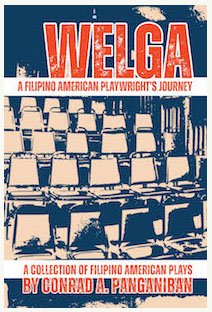
WELGA
A Filipino American Playwright's Journey
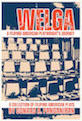
WELGA, A Filipino American Playwright’s Journey—A Collection of Filipino American Plays is a reflective journey through the life and career of Filipino American playwright conrad A. Panganiban. The book chronicles his evolution from an unlikely theater artist—raised in a military family with little exposure to the performing arts—to a dedicated storyteller committed to amplifying Filipino American narratives on stage.
The book culminates in a collection of plays, including WELGA, a powerful story inspired by the Filipino labor movement during the 1965 Delano Grape Strike. Through his journey, Panganiban underscores the importance of representation in theater, the power of storytelling to preserve history, and the resilience of the Filipino American community.
PRAISE for WELGA
The art of storytelling is a gift. Storytellers help to keep the culture, strengthen identity, and build community. Conrad Panganiban does just that through his plays. Conrad helps us understand our experiences as Filipino- Americans. Having performed in Conrad’s debut play, “Hangga't Kaya Kong Pangarap (As Long As I Can Dream)”, I witnessed how his work evokes pride and inspires self-discovery.
The plays that Conrad has written, whether about the 1930 Watsonville Riots (“Standing Above Pajaro”), the 1965 Delano Grape Strike (“WELGA”), or identity differences (“Inay’s Wedding Dress)”, all move us to self-reflection on our personal experiences being Filipino/a/x in America. These plays also ask us to unpack practices in our culture that can unite or harm relationships.
As an educator of almost 30 years and as a life-long learner, I consider Conrad Panganiban as a storyteller for our Filipino-American community, and his work as a gift to our community. His plays belong in classrooms, theaters, and communities across the globe.
—Tracie Tagamolila-NoriegaEd.D., Sr. Director of Diversity, Equity, Inclusion, & Professional Learning, Association of California School Administrators
I still remember the first time I was introduced to one of Conrad Panganiban’s scripts, backstage at A-Squared Theatre Workshop's “My Asian Mom,” in 2012, script pages in hand, the buzz of the house just beyond the curtain. I was immediately struck by how his characters leapt off the page: flawed, funny, full of longing, and so achingly familiar. It’s rare to find a playwright whose sense of humor lands so naturally alongside moments of heartbreak and hope. Conrad does this with a kind of ease that feels earned, like he’s writing from the inside out.
As someone who’s worn many hats in our community as an actor, producer, and advocate, I’ve witnessed firsthand how Conrad’s plays light up a room. I’ve seen audiences lean in, laugh out loud, and sometimes wipe away tears. I’ve had the privilege of embodying some of his characters, and every time, it feels less like “acting” and more like honoring stories that have been waiting for a stage.
What sets Conrad apart isn’t just his craft, but his commitment. He writes for us—for Filipino Americans, for anyone who’s ever felt invisible, for those who carry generations of stories in their bones. His new collection, WELGA: A Filipino American Playwright’s Journey, is a testament to that devotion. It’s a chronicle of where we’ve been and a beacon for where we’re going.
To be part of Conrad’s journey is to believe in the power of theatre to heal, provoke, and bring people together. I’m endlessly grateful for his voice, and I can’t wait to see how his words continue to ripple through our community and beyond.
—Ginger Leopoldo, M.A., Executive Director for CIRCA Pintig
With humor, candor, and deep cultural insight, Conrad Panganiban’s WELGA: A Filipino American Playwright’s Journey weaves together history, personal memory, and imagination to showcase voices too often left out of the American stage. His writer's journey demonstrates not only resilience but also the transformative power of storytelling rooted in community and his own life lessons. In “Standing Above Pajaro”, where the protagonist farm worker Celestino Tobera declares (as a rifle is pointed at him), “Look at my hands. LOOK AT THEM! These are the hands of a person who has worked to be a part of that dream!”, Panganiban dramatizes the search for belonging in between Filipino and American. This collection is at once an archive and a beacon—preserving history, illuminating identity, and inspiring the next generation of Filipino American playwrights to take their rightful place on the “mainstream” stage.
—Allan Samson Manalo, Co-Founder of Bindlestiff Studio
Over the years, Conrad proves his eager search for Story many times, not only by us who count his plays but also by others seeing where and when he appears: in communities, crowds, and many classes, reviewing and “re-inventing”. His characters inform us about HIS observations and his take-aways. Read his work; revel in each’s exploration of humanity and of Self; his confidence in his presentation and Power of the Pen imbue each beat. Now THAT’s a honed writer.
—Jeannie Barroga, Playwright
The play, “Welga”, speaks to the spirit of the Filipino American community in San Francisco, and beyond. Conrad Panganiban highlights the SOMA Pilipinas neighborhood, capturing the energy of the youth and a teacher who sees their potential and power. “Welga” is just as relevant today as when it was first staged at Bindlestiff Studio in 2017—as we continue to fight against cultural and historical erasure with Ethnic Studies under threat. The play asserts that history and hope are intertwined and Conrad beautifully weaves the past with the present, and ultimately the future.
—Aureen Almario, Artistic Director, Bindlestiff Studio
At the core of Conrad’s storytelling is a careful attention to developing characters whose attributes articulate the intricacies and depth of the Filipino American experience. Working on “The Perfect American” and “Daryo’s All American Diner”was a delight for they portray complex characters endowed with wit, humor and pathos. As a director, creating the dramatic life of characters on stage rests not only on motivating actors that breathe life to them, but also on a conscious character design and intent that animate a playwright's grip on humanity. And if a playwright is profoundly inquisitive and collaborative as Conrad is, the stage can be an exciting mirror of reality that can be political as it is poetic.
—Louie Pascasio, Ph.D., Former Artistic Director, CIRCA Pintig
Conrad Panganiban's work reflects an infinite care and deep commitment to ensuring that Filipino history is remembered in every corner of the American landscape. Whether through an intimate family history unfolding in a quiet living room or a powerful exploration of Filipino activist culture, his plays resonate deeply with every audience member.
—Lorna Velasco, Former Artistic Director, Bindlestiff Studio
Copyright @ 2026 PAWA, Inc.